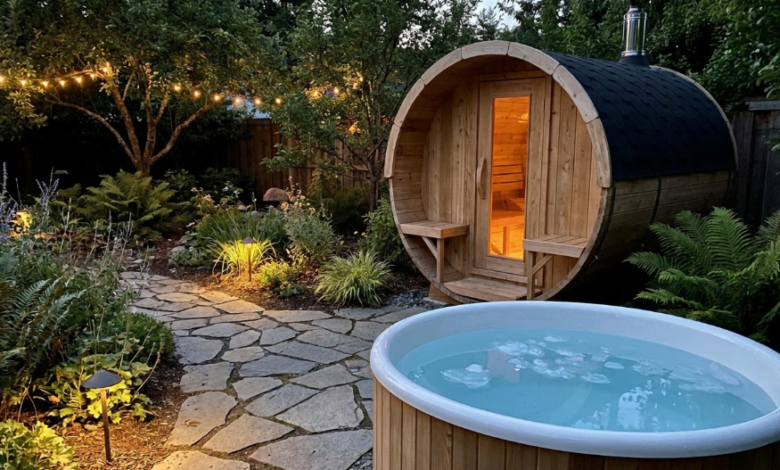
A DIY sauna kit makes sense for confident builders willing to spend one or two full weekends on assembly, and it typically saves $1,000 to $3,000 in labor on a mid-size cabin. A professional install makes more sense for anyone without carpentry experience, tight timelines, or a heater above roughly 6 kilowatts, since that generally requires a licensed electrician regardless of who assembles the cabin itself. Most buyers land somewhere in between: DIY assembly of the panels, with the electrical hookup handled by a licensed professional.
What Does a DIY Kit Actually Involve?
Most DIY sauna kits ship as pre-cut tongue-and-groove panels, a benching system, a door, and a heater, with assembly instructions similar in complexity to a large shed kit. Two people working together typically finish a standard prefab panel cabin in one to two full days, not counting site prep like leveling a pad or pouring a foundation, which usually happens before the kit even arrives. Log or timber-frame kits, and anything custom-cut rather than prefabricated to standard panel sizes, take meaningfully longer and lean more toward a skill level closer to general contracting than furniture assembly.
Where Does DIY Actually Save Money, and Where Does It Not?
The savings show up almost entirely in carpentry and finish labor, the part of the job a reasonably handy homeowner can genuinely do themselves. Electrical work is a different category. Most residential sauna heaters above 6 kilowatts need a dedicated 240-volt circuit, and in most areas that work legally requires a licensed electrician and a permit regardless of who built the cabin around it. That means a fully DIY build still usually carries a real electrician’s bill, which narrows the total savings compared with a full professional install, sometimes significantly, once that line item gets factored in honestly rather than left out of the comparison.
What Skills Does a DIY Build Actually Require?
Basic carpentry competence covers most of it: reading panel assembly instructions, using a level, and handling standard fasteners without stripping them. The part that trips up first-timers most is not the assembly itself but the tolerances, since a sauna cabin depends on a tight door seal and gap-free panel joints to hold temperature efficiently, and small gaps that would not matter on a garden shed noticeably hurt heater performance on a sauna. Anyone who has successfully assembled flat-pack furniture or a basic shed kit before has a reasonable shot at a panel-based sauna kit; anyone starting from zero carpentry experience should weigh that honestly against the time and frustration a mismatched panel gap can cause partway through.
When Does a Professional Install Clearly Win?
Three situations point clearly toward professional install. First, any timeline pressure, since a professional crew typically finishes in a fraction of the time a first-time DIYer needs, gaps and rework included. Second, any site with unusual grading, drainage, or access challenges, where site prep mistakes are expensive to fix after the fact. Third, anyone without confidence in basic carpentry, since a poorly sealed or unevenly assembled cabin underperforms for years, not just on day one, and the cost of professional assembly is often modest compared with years of a heater working harder than it should to compensate for gaps in the build.
Is a Hybrid Approach the Most Common Choice?
In practice, yes. Many buyers assemble the cabin panels and interior finishing themselves to save on labor, then bring in a licensed electrician specifically for the dedicated circuit and heater hookup, which is the part of the job with real safety and code implications. This split captures most of the DIY savings on the labor-intensive but lower-risk carpentry work, while keeping the higher-risk electrical work in the hands of someone qualified and licensed to do it, which also tends to keep the heater’s warranty intact, since many manufacturers specifically require licensed electrical installation as a warranty condition.
What Does the Evidence Say About Getting a Sauna Actually Built and Used?
Whichever install route gets chosen, the goal is the same: a cabin that reaches temperature reliably and gets used consistently over years, not months. A 2018 review in Mayo Clinic Proceedings and a related review of the benefits and risks of sauna bathing in The American Journal of Medicine both describe cardiovascular and general wellness associations built on sustained, frequent use over long periods. A systematic review in Evidence-Based Complementary and Alternative Medicine reaches similar conclusions. None of that research distinguishes between a DIY-built and professionally installed cabin, but a poorly sealed DIY build that struggles to hold temperature, or a build project that stalls out half-finished, delivers neither the comfort nor the consistent use those studies describe.
How Should You Decide Between the Two?
Start with an honest read of available time, carpentry confidence, and local electrical code requirements, then price both routes fully, including the electrician’s bill under the DIY option rather than assuming it away. Comparing a fully assembled model’s total installed price against a DIY kit plus a realistic electrician quote gives a more honest picture than comparing sticker prices alone; one specialty retailer worth checking lists both DIY-friendly kits and fully installed options side by side with separate pricing for each, which makes that comparison considerably easier than pricing everything out from scratch on your own.
Frequently Asked Questions
How much does a DIY sauna kit save compared to a professional install? Roughly $1,000 to $3,000 in labor on a typical cabin, though the gap narrows if a licensed electrician is still needed for the heater circuit.
Can I install the electrical wiring for a sauna heater myself? Usually not for a dedicated 240-volt circuit, which typically requires a licensed electrician. Lower-power 120-volt infrared units are more often DIY-friendly.
How long does a DIY sauna kit take to assemble? One to two full days for two people on a standard prefab panel kit, not counting site prep or electrical work.
What is the biggest risk of a DIY sauna install? Panel gaps and poor door seals are most common; electrical shortcuts are the more serious risk to safety and to the heater’s warranty.
Is a hybrid approach, DIY assembly plus a pro electrician, common? Yes, it is the most common approach, capturing carpentry savings while keeping the higher-risk electrical work licensed.
References
- Benefits and risks of sauna bathing, The American Journal of Medicine, 2001
- Does the Combination of Finnish Sauna Bathing and Other Lifestyle Factors Confer Additional Health Benefits? A Review of the Evidence, Mayo Clinic Proceedings, 2023
- Clinical Effects of Regular Dry Sauna Bathing: A Systematic Review, Evidence-Based Complementary and Alternative Medicine, 2018